
by Chloe Newton
Every year, we get told that college is the key to success. Teachers, parents, and counselors repeat the message like a mantra: “Work hard, get good grades, get into the best college you can.” But few talk about the price of that advice, not just the tens of thousands of dollars many families can’t afford, but also the toll it takes on students’ mental health and sense of purpose.
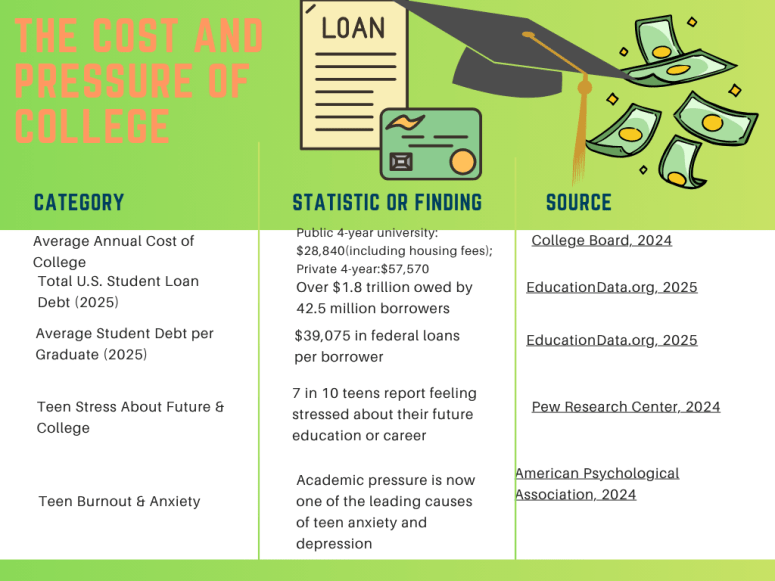
Today, the path to higher education has become an issue that teens can’t afford to ignore. College costs have climbed faster than inflation for decades. According to the College Board’s 2024 Trends in College Pricing Report, the average annual cost (including tuition, housing, and fees) is about $28,840 for public universities and $57,570 for private colleges. That means a single four-year degree can easily exceed $100,000. Meanwhile, the total U.S. student loan debt has reached $1.8 trillion.
The result is a generation that feels trapped in anxiety. We are told that college is essential to success, yet the financial reality makes it nearly impossible to pursue it without incurring debt. This system pressures us to make life-altering decisions before graduating from high school, often without a clear understanding of the financial implications of debt.
Even worse, the cultural obsession with “the perfect college” has turned education into a competition rather than an opportunity for growth. A 2024 Pew Research Center survey found that seven in ten teenagers feel stressed about their future education or career plans. The American Psychological Association reports that constant academic pressure is now one of the leading sources of teen anxiety and burnout. When students feel their worth depends on getting into a top school, learning becomes secondary to surviving the system.
This issue goes beyond money- it’s about values. Society has built a narrative that college is the only path to success, when, in reality, the Bureau of Labor Statistics reports that many skilled trade jobs, such as those in electrician and technician roles, or healthcare assistant positions, are growing faster than the national average and often require less than a four-year college degree. If this trend continues, we risk creating a future where only the wealthy can afford education without hardship. That’s not opportunity – that’s inequality. It’s time to rethink how we define success for teens and how schools prepare us for life after graduation.
To move forward, we need action on several levels. Schools should provide transparent financial education, showing the real college costs, interest rates, and repayment timelines before students apply. Counselors should present multiple paths —trade programs, community college, or apprenticeships—without treating them as “less than.” Lawmakers must invest in making public education more affordable, expanding Pell Grants, and capping interest rates on student loans. Students can speak out by writing, organizing awareness campaigns, or advocating for school boards to include financial literacy in their graduation requirements.
Redefining success doesn’t mean giving up ambition but making it sustainable. The dream of college shouldn’t come with a lifetime of debt or exhaustion before adulthood even begins.
Education is supposed to open doors, not lock students into decades of repayment and pressure. Until we fix the system, the actual cost of college won’t be just financial- it will be the mental and emotional price our generation pays for chasing an idea of success that no longer fits our world.
 thehyphennews.com
This is an excellent piece that raised real and important concerns. Kudos to Chloe for raising them. I hope those with the power to make the changes she recommends will listen.
LikeLike