
by Sam Ottinger
AI has had an ever increasing prevalence since OpenAI’s introduction of DALL-E in January of 2021, and ChatGPT in November of 2022. It has been a popular addition to company websites, search engines, and social media platforms.
The presence of artificial intelligence is nothing new, for Tik Toks “For You” page is able to be what it is due to the use of AI to personalize recommendations for each user. This is similar to X, formally known as Twitter, that also uses this same type of algorithm-based timeline, starting all the way back in 2016.
Yet the current use of generative AI, now not just relying on analyzing existing data, but instead using this data to “create” text or images, is more invasive than it has ever been.
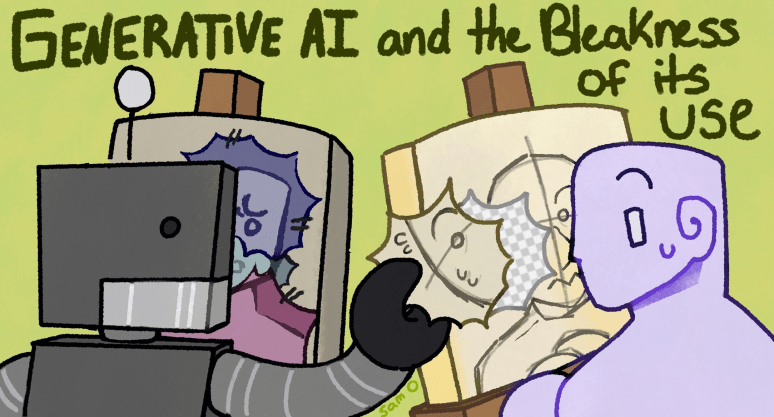
It’s hard to go onto any major platform without running into generative AI being implemented within it. Search engines like Google have Gemini, website creators like Squarespace have Squarespace AI, and social media companies like Meta have Meta AI.
Many of these inclusions come with a lesser known contract to those that use it. For some companies, this use of AI features gives them permission to use the users data to train their AI models.
Even those that don’t use these tools, or specifically opt out of this use, can still have their work used against their will.
This has been a major problem for many creatives, especially with the presence of popular generative AI websites like DALL-E 2, Midjourney, Craiyon, and recently ChatGPT. Each using datasets, often scrapping images and artworks from artists and photographers all over the internet, in order to produce images that try to replicate their human creation.
Generative AI isn’t just used by a subset of individuals; it’s also found its home through different social media trends.
Some have participated in generating turnarounds from an image, also known as the microwave trend, while others have used it to turn themselves into dolls, mimicking the style and packaging of Barbies or classic action figures. Yet most recently there has been a trend of turning images into the style of Studio Ghibli, using ChatGPT.
This latest trend has caused the most controversy. Hayao Miyazaki, a co-founder of the aforementioned studio, has been outspoken of his dislike of AI since all the way back in 2016. In a documentary called “Never-Ending Man: Hayao Miyazaki,” he comments on an AI-generated demo shown to him, stating that AI’s use is “an insult to life itself.”
This dislike of the technology producing these images has caused many Ghibli fans to be concerned about the disrespect of using AI to copy the hand drawn and intricate style of the real Studio Ghibli – only producing a cheap soulless copy.
The hate on generative AI isn’t only for the stealing from others’ works; it’s also the way its presence has been used to put down the creatives that made it. Many who swear by AI-generated images boast about the quick generating speeds and how it puts out near “perfect” products in that shorter time frame, ignoring the true meaning of creating something through your own living hands.
Without genuine human creation in the world, there would be no data for these AI models to rely on, showing the hypocrisy of this belief that generative AI will somehow ever replace the value in handmade media.
 thehyphennews.com