
by Tyler Anthony
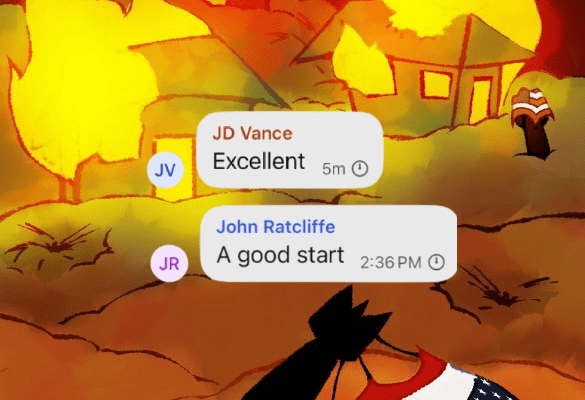
Once again the fascistic phenomenon that is the Trump administration has made headlines with its incompetence. On March 24, Jeffery Goldberg — former IDF prison guard and editor-in-chief of The Atlantic — reported that he had been added to a Signal group chat containing members of the Trump Administration.
The group chat discussed the bombing of the Yemeni supposed terrorist organization “The Ansar Allah,” also known as “The Houthis.” Goldberg assumed it was nothing but a prank until the bombs actually started falling.
The Atlantic article and other large media corporations responded to this situation by attacking the incompetence of the administration. Yes, it is incredibly ignorant management, but the texts themselves should be subject to scrutiny.
The media has not responded to the plain-as-day texts that speak of a situation that involved bombing a suspected terrorist’s girlfriend’s entire complex, only the boyish behavior exhibited in their words. None of these media organizations have responded to the casual bombing of civilians. Therefore, none of the media should be trusted.
It should go without saying that the situation in the Middle East is extremely nuanced and should only be approached with an understanding of each of these group’s actions, goals and effects they have on and within the region.
So, who are these groups?
The American and Israeli governments, and Hamas and Ansar Allah, who have all exploited the Yemeni and Palestinian people, through ruthless violence and extremist ideology.
The media remains very removed from the Ansar Allah, referring to them by the name of their now dead ideological figurehead, Hussein al-Houthi. We must ask ourselves: Why does the media so simply write off one group as the terrorists? Why do corporate media conglomerates swing radically to the right, but swing only moderately to the left? What changed in our culture to incite this?
Of course these questions are all indicative of wider systemic issues, but the skepticism should still hold when dealing with how we identify groups of people. Why do the masses accept that the Ansar Allah are simply radical terrorists, while our government and its allies are not.
But how could I say this? Well, let’s define some terms.
The United Nations classifies terrorism as “criminal acts, including against civilians, committed with the intent to cause death or serious bodily injury, or taking of hostages, with the purpose to provoke a state of terror.”
Merriam-Webster defines “radical” as something relating to the root or origin, fundamental, extreme, or favoring extreme change, often used in political or social contexts.
The Ansar Allah is an insurgent group in Yemen. The attacks they have perpetrated on cargo ships in the Red Sea — often referred to as simply “The Red Sea Crisis” — are from their point of view to stand in solidarity with Palestine and the genocide in Gaza. However, the U.S. government frames them as terrorists.
The claim from the U.S. government, in Donald Trump’s own words, is that the Ansar Allahs “piracy, violence, and terrorism” had cost “billions” and put lives at risk, that it is Iran who is funding them. Iran denies this, claiming purely ideological support. Notice how the first concern was the money.
In the text messages within the White House group chat, these infantile men casually gloat and exchange emojis, while talking about the bombing of a suspected terrorist’s girlfriend’s apartment. How could you say this isn’t inflicting terror? So many lives were devastated and taken in an attack on someone who was suspected a radical terrorist and judged as such.
My point isn’t to moralize the Ansar Allah, but to compare what they are being labeled as to the U.S. government. And, yes, I am talking to you, the average U.S. citizen. I do not acknowledge the oppressive actions and propaganda of our government as indicative of my true beliefs of Truth, Liberty and Peace.
These ideals are not utopian or naive. They are the future, a future we can all start building to.
 thehyphennews.com