by Viviana Gonzalez Chavez
AI, or artificial intelligence, is not a new concept. Since the 1950’s we have been exploring and attempting to understand the depth of artificial intelligence.
Although it has been around for some time, in recent years AI has become more involved in our day-to-day lives than ever. So many people will tell you so many things about it, some in favor while others not.
The term “artificial intelligence” was first coined by professor Darth McCarthy at Dartmouth College (a private Ivy League research university) in Hanover, New Hampshire. During his time there he held a conference in order to discuss his findings from a summer workshop he sponsored to “refine and develop ideas about “thinking machines.”
Since then we have done nothing but continue what he started, to explore in depth the power and limits of AI. Overtime we have incorporated it more and more into our daily lives. Artificial Intelligence has become so common in fact, a survey done by Pew Research found that around 55% of Americans in 2024 claim to regularly use AI.
Most common people who use it tend to be students too, especially with the normalization of AI in things like social media, but now more than ever in schoolwork with a surge of copying. Students have been caught copying straight from AI generated answers on websites like ChatGPT and OpenAI.
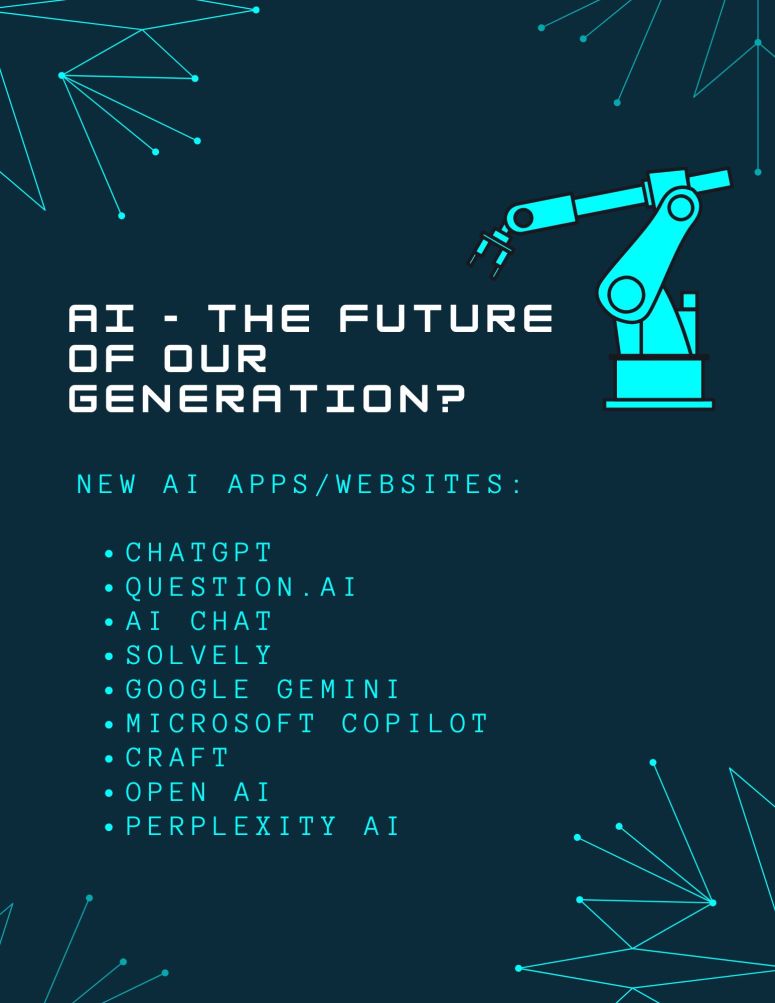
Many teachers and students alike have different views on just how much AI is being used nowadays, some supporting it and others degrading it.
When asked about the recent increase of AI usage in schoolwork, health teacher Charles Patton said, “I’m okay with it, as long as they are not regurgitating it straight off of AI. I very much believe that when I hand out a worksheet I want them to think outside the box. In research and in any field, you’re going to have to be able to write, and if that helps then I’m okay with it.”
And although some teachers like Patton have begun to accept it and look for ways to help students utilize it properly, other peers have different views.
“I think people rely on it too much;, you need to use your own creativity for inspiration. It’s dwindling down the creativity of our generation,” stated sophomore Ariana Adams.
But how can you know for sure where we should draw the line? But would it be fair to keep something that allows for this much freedom?
Sophomore Laela Rudicel explained, “I think it helps a little bit if you want to get the answers right then and there but like I said, if you really want to do something with that information then you should learn it on your own instead of using AI.”
Of course, using it properly should be of utmost importance in the classroom, but what’s to stop students from copying? Many modern videos and photographs are AI generated, fake, and made up for different purposes, creating a question as to what to trust.
Despite these questions, some believe AI has benefits.
“I also think it can be helpful to check your work, make sure that work is proper, sounds good, makes sense so then you have better essays to submit. Also, like if you don’t even know what you’re doing it can be used to teach you and help you out and explain in other ways that your teachers may not,” said sophomore Camden White.
Everyone is different and everyone is able to make their own opinions, some arguing that AI will only continue to grow and that we should simply learn to conduct ourselves appropriately with its help. Meanwhile, other staff and students think we should outright ban the use of AI on schoolwork altogether, claiming it will only worsen learning.
Will we ever know, is the question. For many years we have thought of our future with hyper realistic AI robots taking over the world, wiping us of existence. And yet we also see them as the most helpful and adaptive tools mankind has ever created.
So, what do you think? Will AI really be the beginning of our demise, or will it allow for us to grow as a society? Will we ever see a time where students and teachers alike agree on the learning capabilities and drawbacks of artificial intelligence?
Teachers debate AI use in the classroom
by Presley Scott
Artificial intelligence can be a controversial topic that has many different perspectives. Some people believe that help from robots may spark greatness, while others believe that it’ll spark the downfall of critical thinking. Each year, the capabilities of AI advance, and it leaves people questioning if this should be celebrated, or more controlled.
AI is a computer that is programmed to think how humans think, act, feel, and much more. The idea of creating it was conceived by American Computer Scientist John McCarthy in 1955. Since then, AI has advanced rapidly.
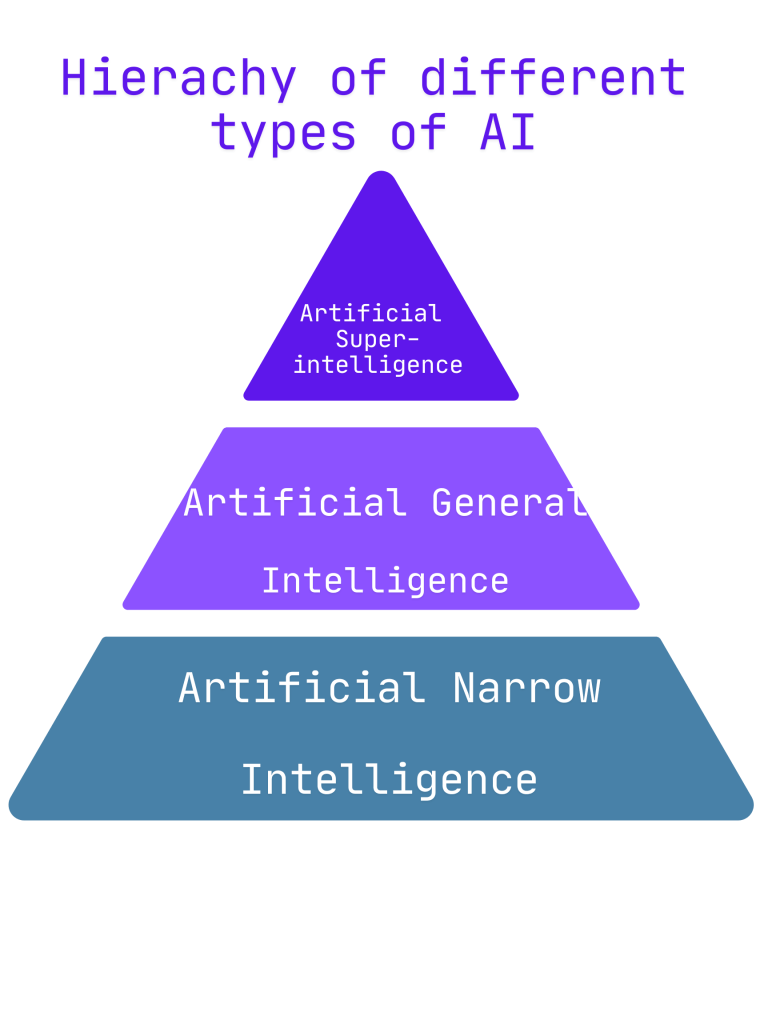
There are now two different systems of AI and four different types of AI. The three systems are called Artificial Narrow Intelligence, Artificial General Intelligence, and Artificial Superintelligence.
Artificial Narrow Intelligence (ANI)
ANI is the weakest type of artificial intelligence. Its capabilities are very limited, meaning that it can only handle one task at a time and isn’t as advanced as the other AIs. This particular type of AI could be ChatGPT, Siri, Alexa, and much more.
Artificial General Intelligence (AGI)
AGI is the AI that is supposed to be on the same thinking level as humans. It can also behave like humans. This particular version of AI was hard to find examples of because it is still actively being worked on, but its products will have human-like capabilities.
Artificial Superintelligence (ASI)
ASI is the highest tier of AI. The idea of this version is to be smarter than humans and to have a consciousness. This would be in the areas where humans cannot see full aspects all the time, like in medicine and engineering. This hasn’t yet been developed, though, due to it naturally being complex.
The type of AI that is being found in students’ work now would be ANI. Apps like “ChatGPT” and “Grammarly” can be either helpful or harmful to students. There’s the perspective of it being an assistant to students for helping them with their work, but there’s another perspective of it potentially assaulting the student’s future work effort.
Teacher Opinion
To get a closer look into this potential uplift or downfall in academics caused by AI, teachers have to closely analyze the smallest changes in their students, as well as their work. These small details can determine what AI’s effect is on the upcoming generations.
“Personally I haven’t noticed any changes in my life because Google Translate has always been a thing, so to me I guess Google Translate is the “A.I.” I’ve dealt with teaching a language, but personally as a teacher, AI can help you make plans such as making slides, so I think that is really cool,” said German teacher Lisa Stumler.
“I think it could be good, it could help students if we’re just talking about the school room. It can help you summarize some things better or get your ideas organized better,” she said.
Whether it’s in or out of the classroom, AI still exists and plays a big part in society now. Stumler goes into detail about how even though we have this great tool, society should still have a dependency.
“For society, that’s what’s scary. We don’t want people who just don’t know how to do anything and they’re just stuck to their phones or computers and they don’t know how to have a conversation or an opinion. So if it’s giving you ideas or if it’s giving you advice, sure I’m all for that. If it’s doing something for you, then I’m not for that,” said Stumler.
Backing up Stumler’s thoughts, freshman math teacher Patricia Midkiff agreed that AI can be used as a tool, but also should be handled correctly.
“If you use it as a way to check your work and to make sure that you’re hitting points and go back reread, that’s different than having it do everything for you because just like everything else, it’ll only do what you put into it,” said Midkiff.
“Honestly in math, we’re just starting to see people use it. If you use it, it can be a great aid regardless of the class. I think it has a lot of potential, but I don’t think it’s what they’re marketing it to be yet. They have a lot of work to do before they can be trusted to do what it’s being advertised as,” said Midkiff.
“I think it’s more teaching people how to use it to advance your work to make it more polished, to use it more like a tool.”
AI can be a helpful assistant, but it can also be harmful to a student’s academic effort and growth. Freshman English teacher David Kummer goes into detail about this and gives further depth to why doing more work can be better than doing less.
“People are going to be finding ways to take shortcuts on work, which isn’t the worst thing, but like I said there’s stuff you have you be able to do by yourself. You can’t always see, like the reason why you’re being asked to do something sometimes is for you to get used to doing things you don’t want to do (academically),” said Kummer.
“As far as my classroom goes, I think I’ve just had to be a lot more watchful for students using it on writing assignments,” he said.
Another observation made by Kummer was how fast AI seemed to enter our lives, and on our personal accounts, devices, and much more so quickly.
“I was really surprised how quickly it took hold like it went from what I felt like in one month, it went from not something that people were talking about to now there’s like an AI plug on my Google Docs that I can’t get rid of. There’s AI on my Facebook and I can’t get rid of it. Anytime I search anything, Google’s first result that pops up is their own AI search of what I just searched, stuff like that. It’s annoying how you can’t opt out of it,” said Kummer.
This kind of introduction to AI could cause it to be resented. Sure, the idea of AI being an assistant to students is nice, but only for the people who want that assistance. The people who don’t are just left to sit with something completely unwanted, which taints their point of view on the robot and makes them feel uncomfortable. Forcing the idea of AI through Google Doc plug-ins or Facebook is very damaging.
“I think that it’s just important to see that it’s important that people are educated about AI and that we see how it can seem like a shortcut, but that shortcuts aren’t always the best, not always good,” said Kummer.
My Personal Opinion
Looking at all the insights, I do think AI could have a great impact on future generations, but that depends on how it is distributed. AI should be a choice, not a necessity. Looking back to what Midkiff and Stumler said, AI could be a great assistant for students when they need help gathering thoughts or creating ideas. On the flip side of what Kummer said, it does seem to be everywhere now, even if you choose it to be or not. The topic of AI is very controversial and does bring up a lot of questions as to what our future will look like, but I believe that if we put limitations on what it can do or be, AI can be a great thing as long as we don’t let it invade our lives.
At the end of the day, AI is going to be in our future. It is all just a matter of how we prepare for that future, and what we walk into it with. A crucial skill for that future is being able to form thoughts of our own, with or without AI. AI will have a memorable impact on the world, but it is up to the world if we let that impact spark creativity, or spark the downfall of critical thinking.
 thehyphennews.com