
by Tyler Conley
Censorship, the most complex and confusing matter of the modern day. All of our life, we’re told that we have a voice. But in reality, do we?
In the past millennium, so much has changed. In this new day and age, the media has changed so much. Over 5 billion people are on the internet at any given time, no matter the time of day. Ever since the internet was created in 1983, it has been monitored heavily, just like all other forms of media at that time.
All forms of media are under watch. And to a certain extent, it makes perfect sense, Freedom of speech and expression does not condone illegal activities. But, is it illegal to have the freedom of creativity and expression?
Youth have less and less of a voice everyday. The only way to change is to make people realize that our voices are just as important as anyone else’s.
In 1985, a group called the PMRC (Parents’ Music Resource Center) was created to monitor music and educate parents on what their children listen to. But, it wasn’t just a suggestion. It seemed more like a law. Headed by former First Lady Tipper Gore, all of the music coming out at the time had to pass through them.
Bands like WASP, Def Leppard, Prince, and Twisted Sister were no match for this organization. And to combat the oppression, some of these artists took to the stand to try and sway their opinion.
Twisted Sister singer Dee Snider was one of the most important and famous cases of the artists trying to take back their music. Twisted Sister’s song “Under The Blade” was the song in question that was going to have his album banned, for allegedly having topics the PMRC thought kids should not know about.
And sadly, all of the fighting was for nothing. They had all decided beforehand their final verdict. The music of the accused wouldn’t be banned, but parental advisory stickers were added to every CD deemed “Nasty” by the PMRC. This is an instance of censorship terribly backfiring.
Kids all over the United States were going out and purposefully buying albums with Parental Advisory stickers. Being a part of the youth today, I would agree that the advisory sticker is eye-catching; it makes me very curious about the material of the album.
Ironically, this almost 40-year-old incident still has relevance because it has not changed.
In March of 2023 in Boise, Idaho, an art exhibit was censored, and teens were told they could not testify in some legislative hearings.
Adults silence teenagers and young adults, telling them what they can or cannot see and listen to. And when young people try to say something about it, we are ignored and told we do know what we’re talking about.
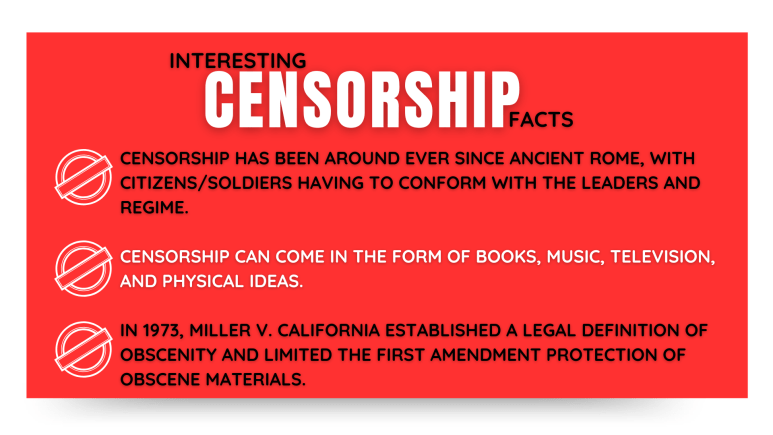
I think there’s a stereotype that teenagers are not knowledgeable enough to speak up. Adults have lived longer than us, but we have the right to live our own lives. No one should have to conform to a certain idea or belief, yet censorship is a growing problem.
“We are seeing tremendous attacks on First Amendment freedoms across the country right now, at all levels of government. Censorship is proliferating, and it’s deeply troubling,” said Joe Cohn, legislative and policy director with the Foundation for Individual Rights and Expression.
And now, we can even be censored for being ourselves.
“This year, we’re seeing a wave of bills targeting drag performances where simply being gender nonconforming is enough to trigger the penalty,” Cohn said.
It’s understandable to dislike or disagree with someone’s idea, but being censored for being ourselves is becoming a serious issue, and it should not be. It’s no one’s business what I wear, what I say or who I am.
We have changed in the United States over the years. Youth have less and less of a voice everyday. The only way to change is to make people realize that our voices are just as important as anyone else’s.
No matter who you are, you have a voice. No one can tell you differently.
 thehyphennews.com