by Sam Ottinger
The focus of WJHI has always been on the subject that they are focusing on, yet turning the cameras back on those running the TV & Radio process is an important part to truly understand the work that they all do.
One of these hard workers is one of the new TV & Radio teachers, Fred Cowgill, who brings his expertise to WJHI and JHS.
As fate would have it, right after grad school, Cowgill would get a position on CNN and be “thrown on national tv,” as Cowgill put it, at the age of 22. After being a stand-in for someone who was sick, he has been on the air ever since.
After spending 44 straight years on air, Cowgill has settled down in JHS’s broadcast department and officially got the job in June. Prior to this, he worked at U of L and WLKY as a sportscaster for 38 out of the 44 years.
He started in Atlanta, Georgia, with CNN Sports, then went on to shift over to ABC Rochester New York for four years, until he made his way down to Kentucky for WLKY, in 1986.
While there, he “fell in love with the city and everything around it,” enjoying the horse racing, like the Derby that he was able to cover for 38 years straight, and the college sports that filled the town. This enjoyment led it to becoming a very personal and bittersweet departure, but as Cowgill put it, it was time for him to go.
Even though he had pursued the live broadcasting side of the industry, he still had just as much passion in teaching. Cowgill graduated with a masters in broadcast journalism, seeing this as the only way for him to get into the business, hoping that one day he would be able to teach. And he got that day after U of L asked him, and he agreed to teach part time back in the 80s. He had then left the teaching business until this past spring to teach a course in Producing Kentucky Derby stories after he retired from his job at WKLY in May.
Now, Cowgill may have been out of his broadcast job, but even in his retirement, the fire to teach had not gone out. He wasn’t sure if he would get another job, even though he was searching, there were none that checked all the boxes.
This also applied to our school when principal Pam Hall and athletic director Larry Owen contacted Cowgill in late May, informing him of the developing position, during his final week at WKLY.
He was willing to listen, but admitted, “At first, when I came over, I was ready to say no a couple times” due to the amount of work it would take for one person, yet Hall wasn’t going to let go of this opportunity. And due to her willingness to help aid the changes Cowgill suggested, he decided to take the job.
Cowgill’s reluctance to take the job was not due to him being picky; it was due to the massive workload that taking this position would have on one person. The lessons he teaches are unlike lessons from the past teachers, which forces him to take the knowledge and reverse engineer it to make an understandable curriculum.
Having to become a master in different editing programs all at the same time can be a struggle, even to those like Cowgill who have been working in this type of field for as long as he has.
This struggle has been eased due to the help from the other new production teacher, David Callan.
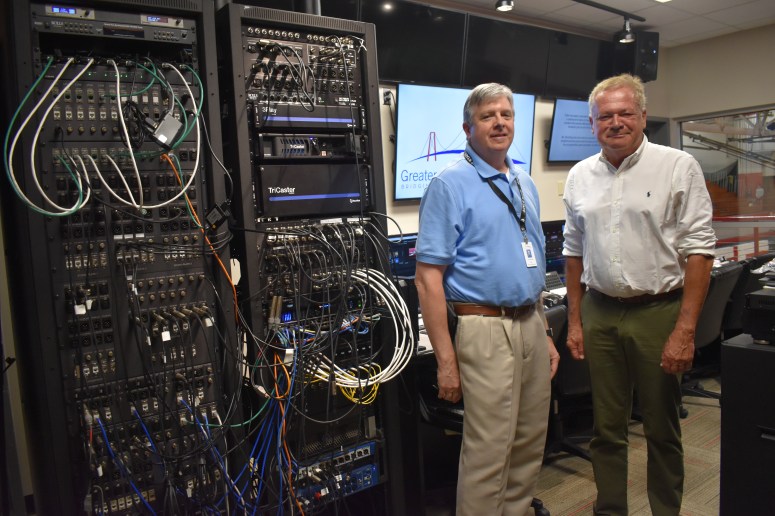
“If that basketball court was Adobe Premier, Mr. Callan could tear it apart and put it back together again, while I just play basketball on it. The same thing is true here. I can play in the neighborhood, I just don’t know how it was built,” said Cowgill.
Cowgill and Callan knew and worked with each other from 1986 when they were both on WLKY, Callan having worked there for 28 years, up until 2003 when Callan transferred to WRDB, where he worked for 21 years. Callan left on a Friday and started working at WRDB the following Tuesday.
Callan started his radio journey as a station runner for WLKY. He would run errands like picking up video tapes, film, and audio tracks.
This may sound like a small job, but this was all prior to his senior year in high school where he was able to get up close and personal to the equipment.
Callan has a total of 49 years in radio, which he’s now leading into his 50th year with working in radio at JHS, and freelance jobs, like working on and off for the Cincinnati Bengals, where he is an operator of the big screens.
Callan “blames Cowgill” for first hearing of the position at JHS when Cowgill brought along Troy Middaugh, Production Manager at Hearst Television, to help him teach the more technical side of TV & Radio. Middaugh was a past employee of Callan, and a past coworker to Cowgill, so he understood both of their abilities and thought that Callan was the one he knew to call.
“I feel honored and blessed,” Callan stated.
Callan said it was as if his planets aligned when he got the call from Cowgill, recalling how his path on WDRB was changing due to choices being made to the station by the owners.
“I helped build something great, and now they wanted me to tear it down”, so when the company was offering people of a certain age early retirement to reduce staff, he took the retirement, unexpectedly by the company, “I’m going to take the retirement, and I’m going to come over here and have fun.”
Hall described the hiring of the new broadcast team as a great moment for the program and the school.
“Any time it comes to bringing on staff to work with our Red Devils, I want to hire the best. I try to swing for the fence, every time. This school year, I was able to hit many home runs with the hires, across the broad in all subject areas. Hiring Mr. Cowgill and Mr. Callan was a grand slam!” she said.
One final project that Cowgill was keen on mentioning was one goal being worked on in TV & Radio, “I am Jeff.”
Similar to the “I am Horseracing” campaign launched in 2019 by those in the industry, in order to improve the public’s view on horseracing, yet this new plan has little to do with horses, and more to do with improving our own self image.
Cowgill stating, “There is a lot more here to be proud of, and people don’t necessarily get that.”
 thehyphennews.com